
Universal Volume Calculator
Calculate the volume of various shapes with precise unit conversions.
About Universal Volume Calculator
Quickly determine the capacity or 3D space of numerous geometric shapes. From simple cubes and spheres to complex cones and cylinders, our universal tool handles the geometry and unit conversions for you.
How to Use
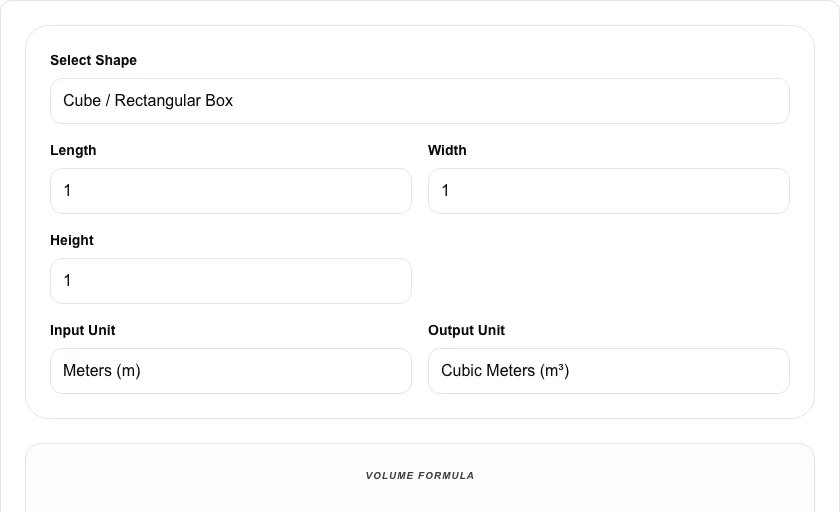
- Select the shape you wish to calculate from the menu.
- Enter the required dimensions (e.g., radius, height, or side length).
- Choose your input units (cm, meters, inches, etc.).
- The volume is calculated instantly across multiple common units.
Common Use Cases
- Estimating the amount of water needed for a pool or container.
- Calculating shipping volumes for packages and logistics planning.
- Solving geometry homework or architecture/design problems.
Technical Details
Implements standard geometric volume formulas for more than 10 different shapes with high-precision unit conversion logic.
Frequently Asked Questions
- Which shapes are supported?
- We support cubes, rectangular prisms, spheres, cylinders, cones, pyramids, and several other common polyhedrons.
- Can I convert between metric and imperial?
- Yes, you can input dimensions in one unit system and view results in another instantly.
- What volume units can I convert between?
- The calculator supports both metric units (millilitres, centilitres, decilitres, litres, cubic centimetres, cubic metres) and imperial/US units (fluid ounces, cups, pints, quarts, gallons, cubic inches, cubic feet). Switch any input and all other fields update instantly.
- How do I calculate the volume of a cylinder?
- Volume = π × radius² × height. For example, a cylinder with a radius of 5 cm and a height of 10 cm has a volume of π × 25 × 10 ≈ 785.4 cm³ (or ~785.4 mL). Enter the radius and height in the cylinder section and the tool handles the rest.
- What's the difference between a US gallon and an imperial gallon?
- A US liquid gallon equals approximately 3.785 litres, while a UK (imperial) gallon is larger at approximately 4.546 litres — about 20% bigger. This matters for cooking and fuel calculations. The converter lets you select which gallon type to use so you always get the right result.
- Can I calculate the volume of a hollow shape like a pipe or tank wall?
- Yes. For hollow shapes, calculate the outer volume and inner volume separately using the appropriate shape formula, then subtract. For example, a hollow cylinder (pipe) has volume = π × (R_outer² − R_inner²) × height. Enter both radii one at a time, note the two volumes, and subtract. The calculator supports cylinders, rectangular prisms, spheres, cones, and more. All calculations run in your browser with no data sent to a server, and results are shown in multiple unit systems simultaneously.
Local processing
Our local file, text and chart tools process content on your device using JavaScript, browser APIs and, where needed, WebAssembly. Our usage events do not include filenames, file contents, input text, chart values, raw errors, emails or license references. Network lookup tools (such as DNS, WHOIS, IP and speed tests) contact external services for their stated purpose. Loading the website, fonts, libraries and models also makes network requests. WebAssembly itself does not prevent network access.