
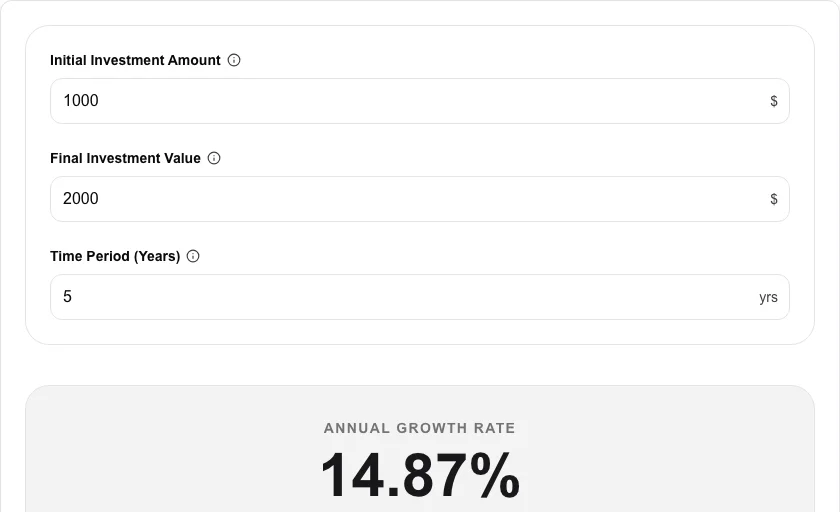
CAGR Calculator
Measure the smoothed annualized return of an investment over a specific time period.
About CAGR Calculator
Evaluate the average annual growth rate of your investments over time. The Compound Annual Growth Rate (CAGR) provides a smoothed representation of returns, making it easier to compare different assets on an apples-to-apples basis.
How to Use
- Input the 'Initial Investment Amount' at the start of the period.
- Input the 'Final Investment Value' or current valuation.
- Enter the exact number of 'Years' between the two dates.
- Review the 'Annual Growth Rate' and the visualized smooth growth curve.
Common Use Cases
- Comparing the performance of different mutual funds or stocks.
- Forecasting future business growth based on historical data.
- Evaluating the return on a startup investment or real estate asset.
Technical Details
Uses the geometric mean formula: ((FV / IV) ^ (1 / n)) - 1. This method accounts for the compounding effect over time.
Formula
Frequently Asked Questions
- What is a good CAGR?
- A 'good' CAGR depends on the asset class and time period. Historically, the S&P 500 has had a CAGR of around 7-10% adjusted for inflation.
- Does CAGR include volatility?
- No, CAGR smoothes out volatility to show what the annual return would have been if the investment grew at a steady rate.
- What formula does this CAGR calculator use?
- The calculator uses the standard CAGR formula: CAGR = (End Value / Start Value) ^ (1 / Years) − 1. The result is expressed as a percentage and represents the annualized growth rate needed to reach the end value from the start value over the given period.
- What counts as a strong CAGR for an investment?
- Context matters, but broad benchmarks help: the S&P 500 has delivered roughly 10% CAGR historically. A CAGR of 15–20%+ is generally considered strong for an individual stock or fund. For a business, double-digit CAGR typically signals healthy growth. Always compare against the relevant industry or index.
- Can CAGR be negative, and what does that mean?
- Yes. A negative CAGR simply means the end value is lower than the start value — the investment or metric shrank over the period. For example, if a portfolio dropped from $10,000 to $7,000 over 3 years, the CAGR is approximately −10.9% per year.
- Does the CAGR calculator support different compounding periods?
- The standard CAGR formula assumes annual compounding and expresses growth as a per-year rate regardless of the actual compounding frequency of the underlying investment. This calculator uses the standard formula: CAGR = (End Value / Start Value)^(1/Years) − 1. It does not adjust for monthly or quarterly compounding periods. If your investment compounds at a different frequency, use the Compound Interest Calculator which lets you select compounding intervals for a more precise result.
Local processing
Our local file, text and chart tools process content on your device using JavaScript, browser APIs and, where needed, WebAssembly. Our usage events do not include filenames, file contents, input text, chart values, raw errors, emails or license references. Network lookup tools (such as DNS, WHOIS, IP and speed tests) contact external services for their stated purpose. Loading the website, fonts, libraries and models also makes network requests. WebAssembly itself does not prevent network access.