
Compound Interest & Savings Calculator
Calculate how your savings or investments grow over time with compound interest.
About Compound Interest & Savings Calculator
Visualize the power of compounding with our advanced savings calculator. This tool helps you understand how regular contributions, interest rates, and compounding frequency work together to grow your wealth over the long term.
How to Use
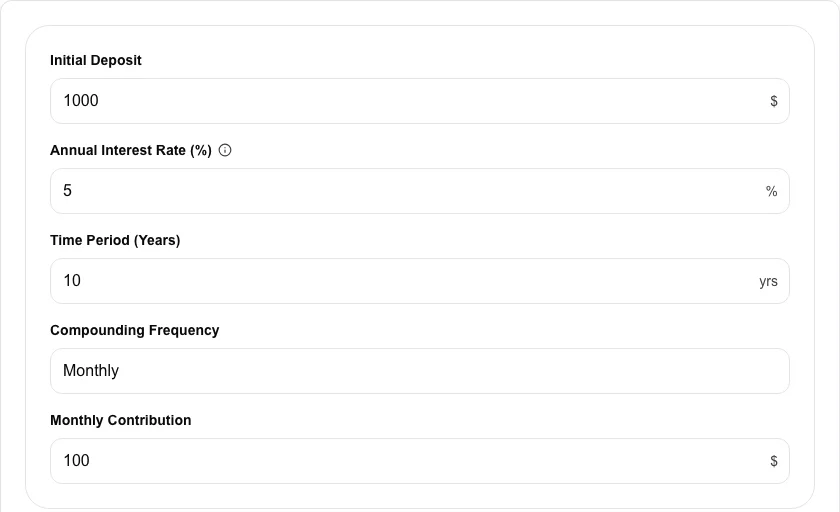
- Enter your 'Initial Deposit' or starting balance.
- Input your monthly contribution and the expected annual interest rate.
- Choose the compounding frequency (Monthly, Quarterly, or Annually).
- Select the investment duration in years and view the projected total balance.
Common Use Cases
- Planning for retirement by projecting 401(k) or IRA growth.
- Saving for a major purchase like a house down payment or car.
- Teaching children or students the benefits of long-term saving and compounding.
Technical Details
Uses the compound interest formula: A = P(1 + r/n)^(nt). Processes all financial projections locally within your browser.
Formula
Frequently Asked Questions
- What is compounding frequency?
- It is how often interest is added to the principal. The more frequent the compounding (e.g., monthly vs. annually), the faster your money grows.
- Does this tool store my financial data?
- No. All calculations are performed on your device, and no financial information is ever uploaded or stored on our servers.
- What formula is used to calculate compound interest?
- The standard formula is A = P × (1 + r/n)^(n×t), where P is the principal, r is the annual interest rate (as a decimal), n is the number of compounding periods per year, and t is the time in years. The interest earned is A − P.
- How much difference does compounding frequency make?
- Quite a lot over long periods. For example, $10,000 at 6% annual rate over 20 years: annual compounding gives ~$32,071; monthly compounding gives ~$33,102; daily compounding gives ~$33,198. The more frequent the compounding, the larger the final balance — though the difference diminishes as frequency increases.
- Does this calculator support regular contributions (DCA)?
- This calculator focuses on a single lump-sum principal. For scenarios where you add money each month — such as a savings plan or dollar-cost averaging — you would use the future value of an annuity formula. A dedicated savings or investment calculator that accepts recurring contributions would handle that scenario better.
- Can I model the effect of inflation on my investment returns?
- The Compound Interest Calculator calculates nominal returns and does not automatically adjust for inflation. To estimate real returns, subtract the expected annual inflation rate from your stated interest rate before entering it. For example, if you expect 7% annual growth and 3% inflation, use 4% as your rate to see inflation-adjusted projections. This gives a rough estimate of purchasing-power growth. For more precise modeling, include the inflation rate as a separate variable in a dedicated financial planning spreadsheet.
Local processing
Our local file, text and chart tools process content on your device using JavaScript, browser APIs and, where needed, WebAssembly. Our usage events do not include filenames, file contents, input text, chart values, raw errors, emails or license references. Network lookup tools (such as DNS, WHOIS, IP and speed tests) contact external services for their stated purpose. Loading the website, fonts, libraries and models also makes network requests. WebAssembly itself does not prevent network access.