
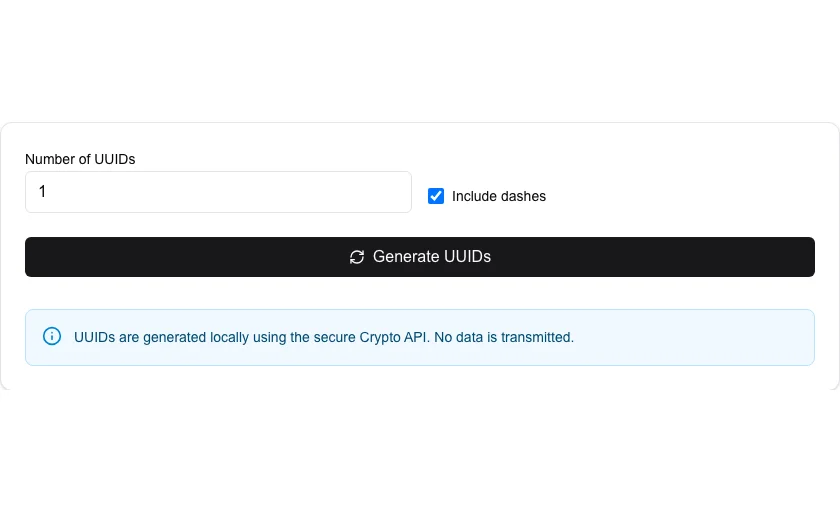
UUID Generator
Generate secure UUIDs (v4) instantly.
About UUID Generator
Generate cryptographically secure Universally Unique Identifiers (UUIDs) instantly. Our tool supports both Version 4 (random) and other standard formats, providing high-entropy strings for databases, APIs, and software development.
How to Use
- Select the 'UUID Version' required (Version 4 is most common for random IDs).
- Click 'Generate UUID' to create a new unique identifier.
- The new UUID will appear instantly in the result field.
- Copy the string and paste it into your code, database, or configuration file.
Common Use Cases
- Creating primary keys for database tables to avoid ID collisions.
- Generating unique session tokens or tracking IDs for web applications.
- Creating unique filenames for cloud storage uploads and data migrations.
Technical Details
Uses the browser's crypto.getRandomValues API to ensure high entropy and compliance with RFC 4122 specification. All generation is on-device.
Frequently Asked Questions
- What is a UUID?
- A UUID (Universally Unique Identifier) is a 128-bit number used to uniquely identify information in computer systems.
- Can I get a duplicate?
- The probability of generating a duplicate UUID is so infinitesimally small that it is considered practically impossible for any real-world application.
- What is the difference between UUID v1 and UUID v4?
- UUID v1 is generated from the current timestamp and the machine's MAC address — it is time-ordered but exposes system information. UUID v4 is randomly generated with no system metadata. For most applications, v4 is preferred because it is more private and collision-resistant.
- Are UUIDs truly unique?
- UUID v4 uses 122 bits of randomness, giving 5.3 × 10^36 possible values. The probability of generating two identical UUIDs is astronomically small — practically speaking, you will never see a collision in any real-world system.
- Can I use UUIDs as database primary keys?
- Yes, and it is a common pattern in distributed systems because UUIDs can be generated client-side without a database round-trip. The trade-off is that random v4 UUIDs cause index fragmentation in B-tree indexes. UUID v7 (time-ordered) or ULID are better choices if insert performance matters.
- Can I generate UUIDs in bulk for use in a database seed script?
- Yes. The UUID Generator can produce up to 100 UUIDs in a single batch. The output is formatted as one UUID per line for easy copy-paste into SQL INSERT statements, JSON fixtures, or seed scripts. All UUIDs are generated using the browser's window.crypto.getRandomValues() function, which provides cryptographically random bytes compliant with UUID v4 specification. No UUIDs are transmitted to any server. For generating thousands of UUIDs in a script, use the uuid npm package or Python's uuid.uuid4() in a loop.
Local processing
Our local file, text and chart tools process content on your device using JavaScript, browser APIs and, where needed, WebAssembly. Our usage events do not include filenames, file contents, input text, chart values, raw errors, emails or license references. Network lookup tools (such as DNS, WHOIS, IP and speed tests) contact external services for their stated purpose. Loading the website, fonts, libraries and models also makes network requests. WebAssembly itself does not prevent network access.
What Is a UUID and How Does Offline Generation Work?
What Is a UUID and How Does Offline Generation Work?
A UUID (Universally Unique Identifier) is a 128-bit label you can generate entirely offline, inside your browser, without contacting any server or central database. Because the mathematical probability of two UUIDs colliding is astronomically low, offline generation is safe — and it is the foundation of privacy-first, local-first application architecture.
Every time you create a new user account, save a document, or generate a unique sharing link, there is a very high probability a developer assigned a UUID to that action.
For a long time, the standard approach to generating unique identifiers was to ask a central database to do it. You send a request to your server, the database increments a number (like ID #1042), and sends it back. It is a reliable system, but it fundamentally requires a constant connection to a central authority.
When we build decentralized apps, local-first software, or privacy-focused utilities, that constant server connection becomes a liability. You cannot rely on a database to tell you what your next ID should be if your app needs to function perfectly offline.
This is where the UUID changes the architecture. You can generate a UUID locally, entirely offline, right inside your browser, and mathematically guarantee it will not clash with any other ID ever generated by anyone else.
What Does a UUID Look Like?
A UUID is a 128-bit label that appears as a 36-character string of letters, numbers, and hyphens.
123e4567-e89b-12d3-a456-426614174000
It looks like random gibberish, but there is a strict structure. The string is divided into five groups separated by hyphens (8-4-4-4-12). While there are several versions of UUIDs, Version 4 (UUIDv4) is the most common for entirely random, offline generation.
In a UUIDv4, a few bits are reserved to indicate the version and variant. That leaves exactly 122 bits for pure, unadulterated randomness.
Why Don't Two UUIDs Ever Clash?
If thousands of different devices generate UUIDs offline, how does none of them end up with a duplicate?
The answer is scale.
Because we have 122 random bits, the total number of possible UUIDv4 combinations is 2122.
To put that into perspective:
2122 ≈ 5.3 × 1036
That is 5.3 undecillion possible IDs.
If you generated 1 billion UUIDs every single second for the next 85 years, the probability of creating a single duplicate (a collision) would still be roughly 50%. Because the collision probability is so astronomically low, we can completely eliminate the database check. Your browser doesn't need to ask a server "Is this ID taken?" — it can just generate the string and assume, with near absolute mathematical certainty, that the ID is globally unique. This is the cornerstone of offline-first application architecture.
From the Developer's Desk: The Pseudo-Random Trap
Building a local UUID generator sounds incredibly simple — it is just random text, right? When I first prototyped the offline UUID generator for LokalTools, I fell into a classic JavaScript trap.
To generate the random bits, I used the native Math.random() function. It was fast, simple, and the output looked completely unique to the human eye.
The Gotcha: Math.random() is not genuinely random. It is a Pseudo-Random Number Generator (PRNG). Browsers implement this using algorithms (like xorshift128+) that are designed for speed, not security or cryptographic entropy. If you use Math.random() to generate UUIDs in a tight loop, the "random" seeds begin to overlap.
In our testing, when we ran a stress test generating 100,000 UUIDs locally using Math.random(), we started seeing collisions. The 5.3 undecillion math falls apart if your random number generator is predictable.
The Fix: We had to rip out the standard math functions and tap into the Web Crypto API. Specifically, we shifted our generation engine to use window.crypto.getRandomValues().
Unlike standard JavaScript math functions, the Web Crypto API taps directly into your operating system's source of entropy. It looks at microscopic variations in your hardware — like CPU thermal noise or keystroke timing — to seed the generator.
By pushing the workload to the OS-level cryptographic API, we guaranteed that the local browser generation maintained true high-entropy randomness. The math was safe again, and everything stayed strictly client-side.
Why Does Local UUID Generation Win for Privacy?
Traditional architectures send a network request to generate or validate a session ID, a document token, or an API key. The flow looks like this:
- Your device pings a server.
- The server generates the UUID.
- The server logs the creation in a database.
- The UUID is sent back to your device.
This approach creates unnecessary network latency and leaves an audit trail on a third-party server. If you are generating a unique encryption key for a secure local document, pinging a remote server defeats the purpose of privacy entirely.
By generating UUIDs locally using the browser's crypto engine, zero bytes are transmitted. The ID exists only in your local system's RAM until you decide what to do with it. In practice, this means your data generation is as private as it can possibly be.
When Does a Database ID Actually Win?
Client-side generation is robust, but it is not the perfect solution for every software engineering problem. You have to be aware of the architectural trade-offs.
Here is the reality: completely random UUIDs are terrible for database performance.
If you are building an application that needs to insert millions of rows into a traditional relational database (like PostgreSQL or MySQL), using UUIDv4 as your primary key causes a problem called "index fragmentation."
Relational databases use B-trees to organize data. They prefer data inserted in sequential order (1, 2, 3, 4...). Because a UUIDv4 is entirely random, the database constantly splits and reorganizes its internal storage tree to fit new records. This creates massive read/write amplification and slows down queries over time.
For high-performance databases, a traditional auto-incrementing integer or a time-sorted UUID (like UUIDv7, which puts a timestamp at the beginning of the string) is fundamentally better.
But for session IDs, offline document generation, idempotent API requests, or building private, local-first tools without relying on an internet connection, local UUID generation remains completely unmatched.
Try It Yourself
Stop pinging servers just to get a unique string of text. Keep your application architecture decoupled and your data private.
Head over to the LokalTools UUID Generator and generate thousands of cryptographically secure identifiers instantly. Watch how fast your own machine can create true randomness, right inside your browser, without a single request ever hitting our backend.
Frequently Asked Questions
What is a UUID? A UUID (Universally Unique Identifier) is a 128-bit identifier standardized in RFC 4122, typically displayed as a 36-character hyphen-separated string. It is designed to be globally unique without requiring a central authority to assign it.
What is the difference between a UUID and a GUID? GUID (Globally Unique Identifier) is Microsoft's name for the same concept. A GUID and a UUID are functionally identical — both are 128-bit identifiers following the same RFC 4122 standard. The terms are interchangeable in most contexts.
Can two UUIDs ever be the same? Mathematically, yes — but the probability is so low it is considered practically impossible. With 2122 possible UUIDv4 combinations, you would need to generate over a billion UUIDs per second for decades before a collision became statistically likely.
Is it safe to generate UUIDs in the browser without a server?
Yes, as long as you use window.crypto.getRandomValues() instead of Math.random(). The Web Crypto API sources entropy from your OS, making browser-generated UUIDs cryptographically secure for use as session tokens, document IDs, and API keys.
What is UUIDv4 vs UUIDv7? UUIDv4 is entirely random (122 random bits) and is best for offline generation where you need privacy and no sequential ordering. UUIDv7 embeds a millisecond timestamp at the start, making it sortable and far more efficient as a database primary key in high-insert workloads.
Why is Math.random() bad for generating UUIDs?
Math.random() is a pseudo-random number generator (PRNG) optimized for speed, not cryptographic security. In stress tests, we found that generating large batches of UUIDs with Math.random() produces collisions because the underlying seed space is limited. Always use the Web Crypto API for UUID generation.
When should I use a UUID instead of an auto-increment integer? Use a UUID when you need IDs to be generated offline, across multiple disconnected clients, or when you don't want to expose sequential record counts to end users. Use auto-increment integers when you need optimal database insert performance in a single centralized system.